


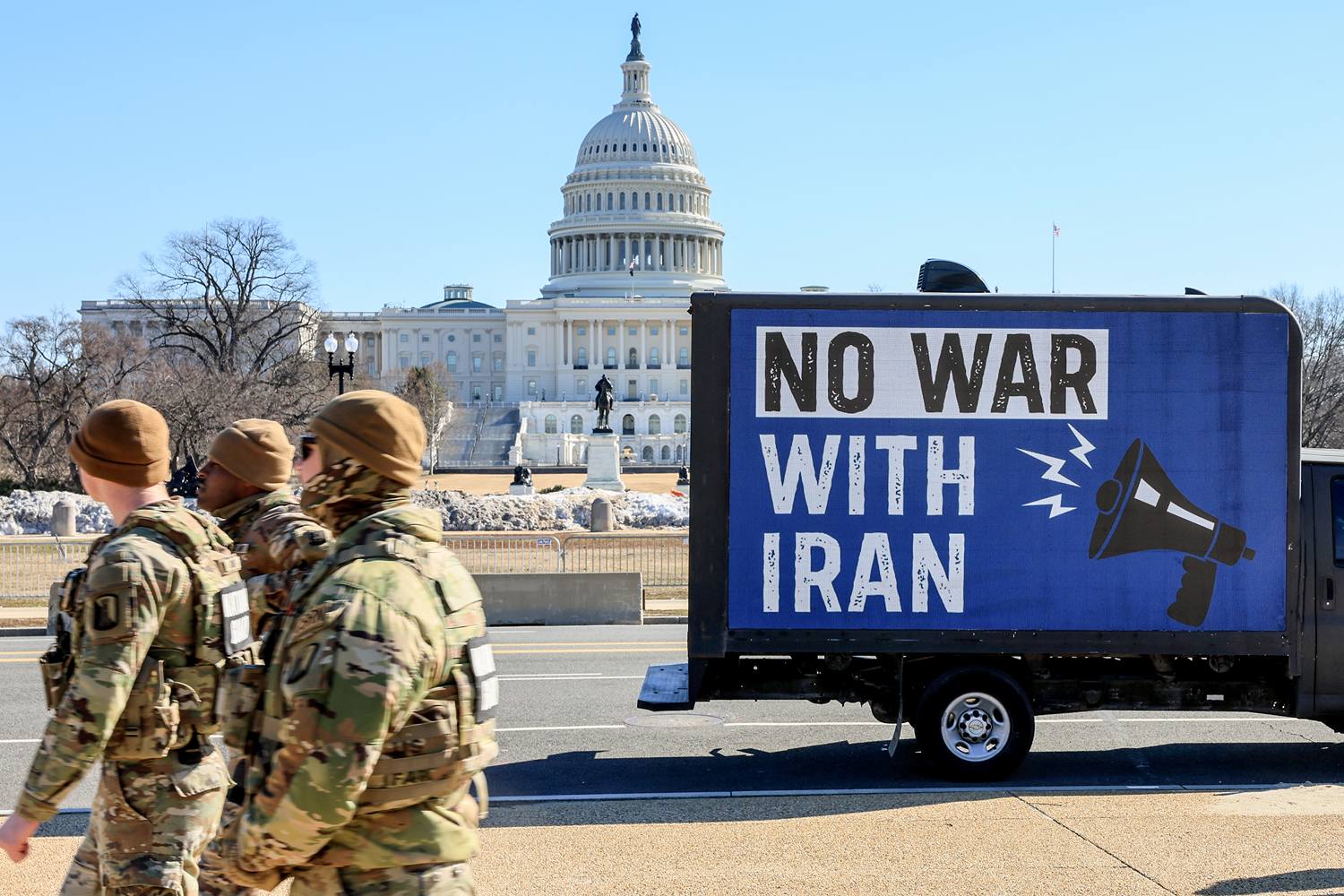
U.S. President Donald Trump’s ongoing war against Iran is increasingly expensive and unpopular. It is also unauthorized and illegal, experts say. Why, then, is Congress seemingly unable to stop him?
The answer is more complicated than one might immediately imagine. It’s not just about a majority of votes in the House or Senate, because the president still has veto power. Lawmakers might have the power of the purse, but even if they somehow mobilized to block funding, it wouldn’t have an immediate impact. And then there are the courts, which lack a clear case to intervene in part because of the precedent that they have already set. The reality is that decades of political polarization, executive overreach, court rulings, and the general acquiescence of lawmakers have collectively brought the United States to a moment where Congress can start wars but do little to end them.
U.S. President Donald Trump’s ongoing war against Iran is increasingly expensive and unpopular. It is also unauthorized and illegal, experts say. Why, then, is Congress seemingly unable to stop him?
The answer is more complicated than one might immediately imagine. It’s not just about a majority of votes in the House or Senate, because the president still has veto power. Lawmakers might have the power of the purse, but even if they somehow mobilized to block funding, it wouldn’t have an immediate impact. And then there are the courts, which lack a clear case to intervene in part because of the precedent that they have already set. The reality is that decades of political polarization, executive overreach, court rulings, and the general acquiescence of lawmakers have collectively brought the United States to a moment where Congress can start wars but do little to end them.
“It’s a tragic commentary on the dysfunction of our political system that a war that is this unpopular can go on and on, and there is no practical way to stop it,” said Michael Glennon, a professor of constitutional and international law at Tufts University. The end result, Glennon added, is exactly the situation that the country’s Founding Fathers had hoped to avoid.
Any good story about a political and legal quagmire should probably begin with an arcane debate over definitions. Is the United States actually at war?
The 1973 War Powers Resolution requires a president to cease unauthorized military operations if they go without congressional authorization beyond 60 days, a threshold that the United States crossed on May 1. The Trump administration has claimed that the president is not bound by that requirement because a cease-fire on April 8 froze the clock and hostilities against Iran “have terminated.”
“That argument is factually and legally untenable,” said Glennon, who served as legal counsel on war powers issues for the Senate Foreign Relations Committee in the 1970s. “Legally, the text of the War Powers Resolution provides no basis for concluding that it’s possible to pause the clock, so I think the argument is frankly close to being frivolous.”
Congress never defined hostilities in the War Powers measure, but according to a December 2025 Congressional Research Service analysis, an official House report accompanying the 1973 law said the term should be understood to mean not just “a situation in which fighting actually has begun” but also “a state of confrontation in which no shots have been fired but where there is a clear and present danger of armed conflict.”
“The president can call the sky green if he wants to, but the fact is that there are hostilities going on that trigger the 60-day clock,” said John Bellinger, who was the State Department’s top legal advisor during the George W. Bush administration.
“If you fire a drone or a missile at our destroyer, what are we supposed to do? Let it hit it?” said U.S. Secretary of State Marco Rubio, speaking to reporters last week in Rome. “Of course we fired back at them. They were shooting at us. That’s what I would expect to do. Only stupid countries don’t shoot back when you’re shot at. And we’re not a stupid country.”
Even as the Trump administration tries to argue that the 60-day clock hasn’t expired on its war of choice with Iran, the president and Rubio are reviving old executive branch arguments that they shouldn’t be legally bound by it in the first place.
Trump has called the 60-day clock “totally unconstitutional,” while Rubio told the press last week that the administration was only complying with “elements of it for purposes of maintaining good relations with Congress.”
So, is there anything Congress can do?
The Constitution’s framers viewed Congress’s power of the purse as an important safeguard to rein in a trigger-happy president. After all, the United States can’t go to war if lawmakers have provided no military funding to do so.
But as the United States’ small standing army from the early 19th century has grown into the world’s most powerful military, its budget and ability to maintain operations for many months without new congressional appropriations have expanded massively. When Trump decided to attack Iran in late February, he was doing so with a considerable war chest.
U.S. defense spending reached an all-time high of a little more than $1 trillion in fiscal 2026 appropriations, which includes an extra $153 billion that Republicans separately approved in their budget and policy bill. The Defense Department has some flexibility to reallocate part of its expanded budget to address needs created by the Iran war, which some Democrats are arguing should be used before Congress considers a supplemental spending request. But while the White House has yet to officially make such a request, Trump has called for an eye-popping $1.5 trillion in defense funding next year.
Democrats could try to attach amendments to any defense spending bills to prohibit funding from going to new offensive military operations in the Iran war. That tactic was successfully used by both Democrats and Republicans in the 1970s to finally end fighting in Southeast Asia following the signing of the Paris Peace Accords.
“The other alternative is not to block it but to try to append an amendment prohibiting any use of funds for continued hostilities or combat operations, just as Congress did in ending the Vietnam War,” Glennon said. “The problem with that is the president might well veto it, and then we’re stuck with exactly the problem that … you need a two-thirds vote to overcome that veto.”
And that’s the reason why the 1970s often come up in these discussions. Back then, a reform-minded Congress not only passed the 1973 War Powers Resolution but also assembled a two-thirds majority to overturn President Richard Nixon’s initial veto. The moment was a reflection of unified public sentiment against the Vietnam War—and also a quainter era when it was easier for lawmakers to cross the aisle.
Historically, presidents from both parties have argued that the law’s imposition of a 60-day clock interfered with their constitutional prerogative to flexibly defend U.S. national interests. Still, the Supreme Court has never ruled against the 60-day clock, and the Justice Department issued legal memos in 1980 and 1993 that acknowledged the validity of the clock.
“For President Trump to cavalierly dismiss the 60-day time period as totally unconstitutional, without so much as an opinion from the Justice Department while these two earlier opinions are standing, is just really quite extraordinary,” Glennon said. “This 60-day time period is not simply some technical contestable legal provision.”
Could the courts do something about the impasse, then?
Federal courts have traditionally deferred to the executive branch on matters of national security. Some legal experts, such as Glennon, argue that this deference is excessive and point to the Founding Fathers’ desire for the legislative branch to have an important voice in the most consequential foreign-policy matters—a vision that they demonstrated by deeding to Congress the exclusive power to declare war and by giving the Senate the power to approve treaties.
Yet the Supreme Court has mostly declined to play referee between the executive and legislative branches on foreign policy. That was the case in 1978, when lawmakers sued over President Jimmy Carter’s unilateral decision to withdraw the United States from a Senate-approved defense treaty with Taiwan. In that case, the court essentially ruled that it was a political dispute that the two branches should work out between themselves. When the Senate failed to pass a resolution to block the withdrawal from the Taiwan treaty, Carter’s decision stood.
By that judicial logic, it’s hard to see how Congress finding the bipartisan willpower in 1973 to overturn Nixon’s veto wasn’t sending the strongest message of legislative determination to reassert oversight on matters of war and peace. But in a separate 1983 ruling, the Supreme Court invalidated one of the law’s core provisions and forcing mechanisms: the concurrent resolution, also known as the “legislative veto.”
The drafters of the war powers law intended for Congress to be able to order an end to military hostilities with only a simple majority vote in the House and the Senate. But the Supreme Court ruling against concurrent resolutions having the force of law resulted in the reinstitution of a much higher political bar: a supermajority vote of two-thirds in each chamber to overcome a presidential veto.
That all amounts to a de facto setup that favors conflict over peace. Congress can declare war by a simple majority vote in the House and Senate, but it requires a near-impossible two-thirds majority to end one. Congress can also approve by a simple majority vote an authorization for use of military force (AUMF).
Many AUMFs remain on the books for much longer than the military campaigns that they authorized. Last December, Congress finally repealed the authorizations for the Gulf War and the invasion of Iraq, approved in 1991 and 2002 respectively. And regardless, a president can still launch an unauthorized military campaign for 60 days, such as the 2011 bombings in Libya or Trump’s current war against Iran, and then prolong the operation using creative legal rationales to argue that the clock hasn’t run out.
This all adds up to an inversion of the Constitution’s design, argued Glennon, who believes that the Iran war has made clear the need to revisit the 1983 Supreme Court ruling that invalidated concurrent resolutions when they are used as a legislative veto.
The court system remains the last hope for anti-war campaigners, but the prospects there are also poor. Previous lawsuits challenging the legality of unauthorized U.S. military operations have run aground in the judicial system over questions of the standing of the plaintiff to file suit. In November 2016, a U.S. district dismissed an Army captain’s lawsuit that argued that U.S. military strikes on Islamic State terrorists were illegal as they had gone past 60 days and Congress had not passed a separate authorization for them. The judge in that case found that the plaintiff had not proven sufficient “injury in fact” and that his claims amounted to “non-justiciable political questions” that did not fall before the purview of the judicial branch.
“These are the sorts of things the courts do not like to get into,” Bellinger said. “The chances that a court would conclude that the president violated Article I by continuing the war are close to zero.”
The congressional war powers struggle will continue this week with fresh votes in the Senate on a joint resolution from Democrats to end the Iran war. But while the procedural legalese may seem arcane, and perhaps pointless, Glennon pointed out that it is in fact part of a long history stretching all the way back to the signing in 1215 of the Magna Carta by England’s King John, a move that established the legal principle that the king it not above the law.
“It is the distillation of 800 years of struggle between parliaments and congresses and presidents and kings to take the power from the hands of a single ruler and place it in the hands of the elected representatives of the people,” he said. “That’s what’s at stake. So, this is really a mammoth constitutional issue.”