


In March 2026, any Google Maps user who looked up Diamond Farms in Franklin County, Missouri, would have found a strange and frightening image.
Processing Content
In what appeared to be an AI-generated photo, flaming horses made of computer parts stomped through a dark, muddy pasture clouded with smoke. Riding the cyberhorse in the foreground was a white-haired man in a business suit, smiling cheerfully at the camera as if for a headshot.
The photo, which has since been taken down, was fake. But the man depicted was a real person: L.B. Eckelkamp Jr., the CEO of Bank of Washington, a $1.2 billion-asset community bank based in Franklin County that has been run by members of the Eckelkamp family for decades.
Why did someone post an image of Eckelkamp atop a burning robot horse? American Banker could not reach the picture’s creator, but one likely explanation is that it was meant to protest the potential use of Diamond Farms as a data center. The Eckelkamp family, which owns the land, has agreed to sell it to a developer that plans to build what it calls the “Gateway Digital Campus,” and since then much of Franklin County has erupted in outrage.
“We’re going to do everything we can to stop it,” Berta Carpenter, a retired information technology project manager who lives just south of Diamond Farms, told American Banker. “We’re not going to give up until we’ve tried every last means that we have to say we don’t want this in our backyard.”
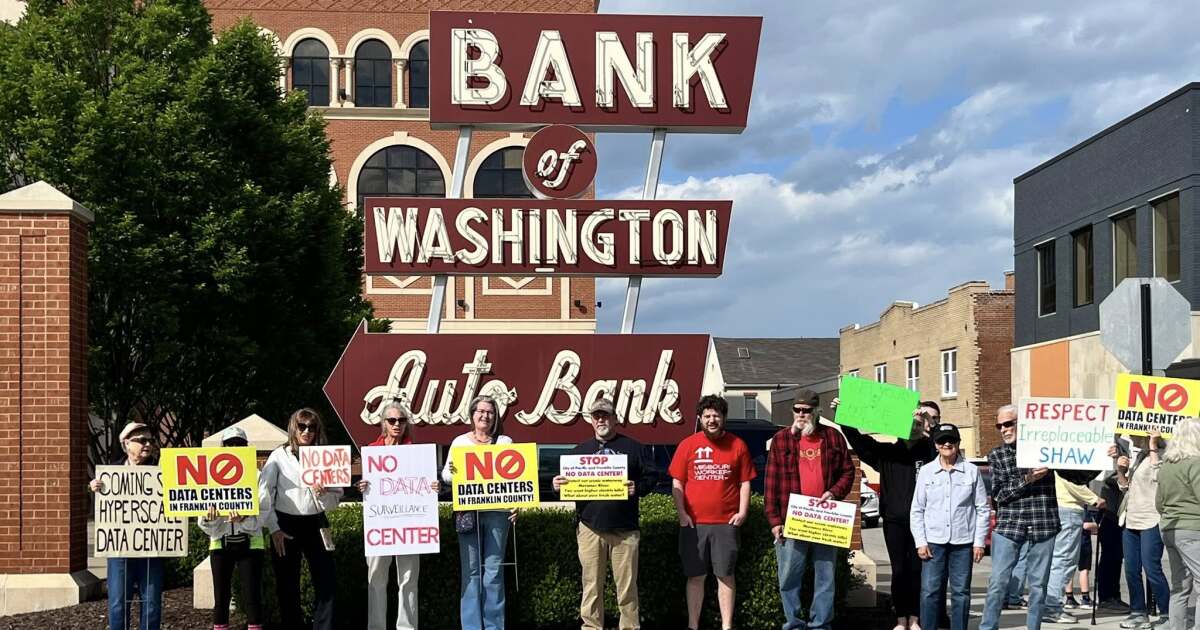
One of those means has been showing up by the hundreds at local government meetings. Another has been picketing outside Bank of Washington’s headquarters. And another, encouraged in multiple Franklin County Facebook groups, has been boycotting the bank’s consumer accounts.
“If everyone simultaneously removed the money and closed their accounts,” one user wrote in the Facebook group “No AI Data Centers in Franklin County,” this would be “a surprisingly easy step to help throw a wrench in their plans for these data centers.” That post was liked 339 times.
In an interview with the
“The land referenced in the proposed data center project is entirely separate from the Bank of Washington and its employees,” Eckelkamp said. “This is a family decision related to the sale of privately held land and is unrelated to the bank’s operations.”
Google Maps
The CEO also declined to tell American Banker how many accounts have been closed.
“We’re aware that individuals have publicly called for a boycott, but many of those making such statements are not Bank of Washington customers,” Eckelkamp said in an additional statement. “As a matter of policy and privacy, we don’t disclose individual customer activity or transaction-level data. Our bank is very strong, well-capitalized, and committed to being here for our communities, as we have for nearly 150 years.”
Whatever the extent of the boycott, the controversy shows the reputational harm that even small banks can suffer when they are seen as taking sides on hot-button issues.
Recently, opposition to data centers has been spreading across the country. In April, the city council of Monterey Park, California, voted to
In Franklin County, residents have made it clear they’re not letting Bank of Washington off the hook. Amanda Tello, Carpenter’s daughter and the co-director of an environmental justice group, said she closed her checking account at the bank as an “act of protest.”
“The community is really frustrated,” Tello told American Banker. “They’re doing this really harmful thing that we don’t agree with, and so we don’t want to give them business.”
Grassroots opposition
Amid the recent AI boom, the construction of data centers has skyrocketed. These giant hubs of computer servers, which can take up hundreds of acres, are used to power a number of rapidly expanding technologies, including AI, cloud computing and cryptocurrency mining. As of April 2026, the U.S. was home to about 3,000 operational data centers, according to the
The problem with these sites, according to critics, is the stress they put on their environments. Data centers require huge amounts of electricity, land and, for cooling purposes, water. And for the communities nearby, their byproducts often include noise and pollution — both from the centers themselves and from whatever local power sources they push into overdrive.
“We’ve actually seen a massive surge in proposed gas power plants, not only from utilities, but increasingly from data-center campuses that want to build them on site,” Jeremy Fisher, principal advisor for climate and energy at the Sierra Club, told American Banker. “That surge is an unparalleled growth in the consumption of gas that has enormous climate consequences.”
Some time in the last two years, the Eckelkamp family entered a contract to sell its 644 acres at Diamond Farms to a developer called Provident Data Centers. The Texas company quietly set about making plans for the site’s construction, working with local government bodies to get the land rezoned for the project.
Then the local community found out about it.
On Jan. 12, a handful of residents near Diamond Farms received a postcard notifying them that a data center was coming to their neighborhood. Word spread quickly on Facebook, and on Jan. 20 a crowd of hundreds showed up to a meeting of the Franklin County Planning and Zoning Commission, overfilling the room and stretching into the hall. The next hearing, held on March 17 at a high-school gym, drew about 850 people and dragged on until
The project’s opponents say the data center will drive up electricity bills, make noise and change the rural character of the area, among other concerns. And they’re concerned not only about pollution from the data center itself, but also from the nearby Labadie Power Station — the largest coal plant in Missouri — which they worry will be used to power it.
“It’s uncontrolled, meaning it lacks modern air-pollution controls,” Andy Knott, deputy director of the Sierra Club’s Beyond Coal Campaign, told American Banker. “So the concern here is that all this data center demand … that’s just going to place more pressure on Labadie to operate more, pollute more, and delay its retirement.”
On a
“We understand that large‑scale projects can raise concerns,” the site says. “That’s why our design, planning, and operations prioritize transparency, environmental stewardship, and being a good neighbor.”
But by potentially pushing the Labadie coal plant into greater use, critics say, Provident’s data center would be anything but neighborly.
“We hoped our community would eventually no longer have to host a power plant, but because of data centers, we will have them forever,” Patricia Schuba, president of the Labadie Environmental Organization and a longtime resident of Franklin County, told American Banker. “So a lot of people are questioning whether or not they should live here.”
The state of play
On April 21, despite months of protests, the Franklin County Planning and Zoning Commission voted 8-1 to approve the rezoning that would allow a data center at Diamond Farms. The question will next go before the Franklin County Commission, which will hold its own hearing and render a final decision.
To the project’s opponents, the fight is not over. Tello, for one, is still holding out hope that enough public outcry will change the Eckelkamps’ minds.
“I understand that money is a driving force in so much of this, but at some point we have to care about our values more than we care about money,” Tello said. “We have to care about the people around us more. And I just wish that those values would come back to them.”
Apart from the hearings and protests, some Franklin County residents are still encouraging Bank of Washington customers to pull their accounts.
“There’s a sense that we may not have much power … but we can remove all our money from their bank,” Schuba said.