


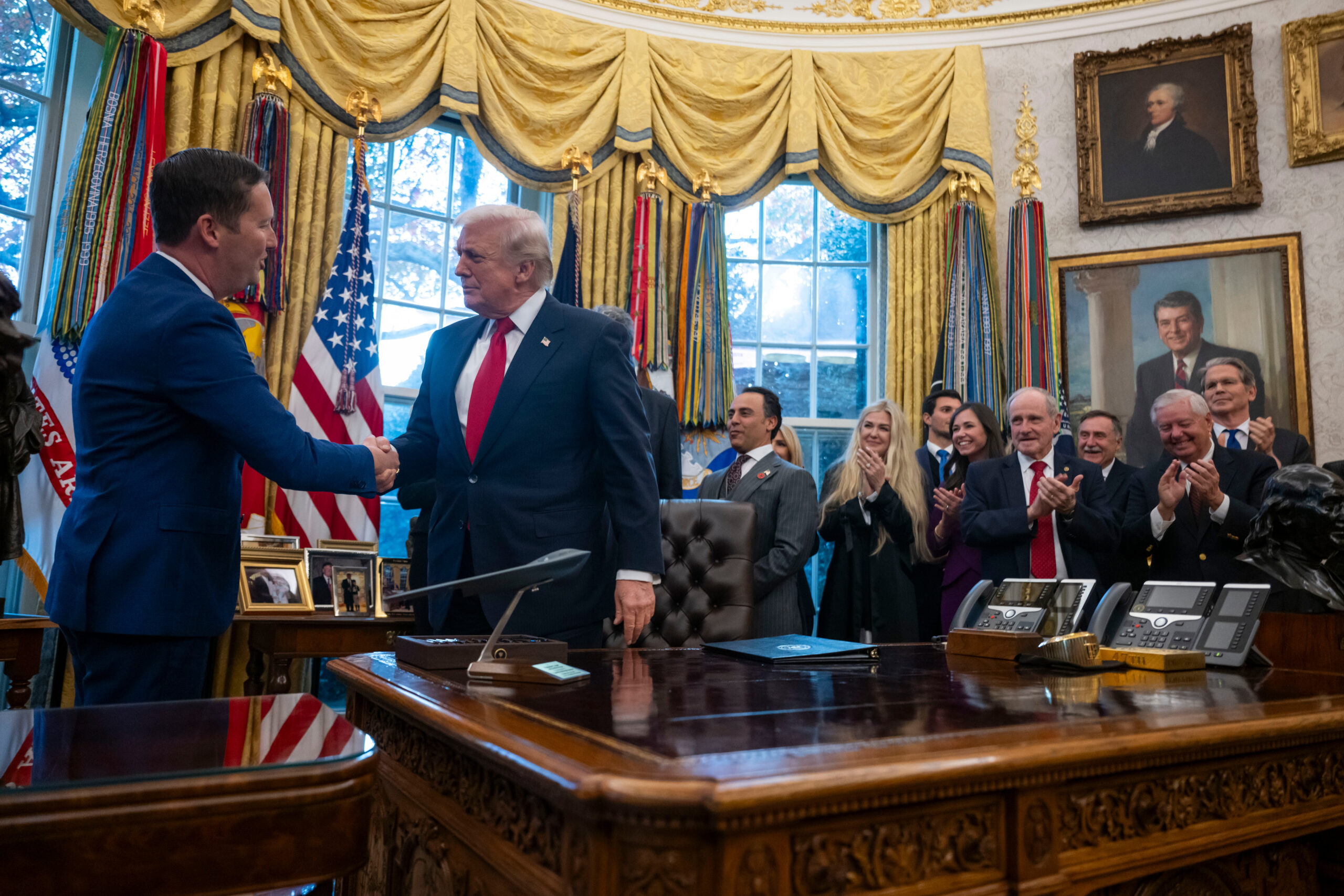
When Sergio Gor left Washington last year, it wasn’t a secret that he had rubbed many in the White House the wrong way.President Donald Trump even joked about it.
But Gor never really left Trump’s orbit. His dual appointments as ambassador to India and special envoy to Central Asia offered Gor a chance to make the kind of deals the president loves, helping explain why the 39-year old, who Elon Musk once called “a snake,” still gets regular face time with the president.
India and Central Asia are critical to U.S. economic and energy interests. India is the fastest growing major economy and Central Asia has vast quantities of critical minerals. The Trump administration wants Gor, who is intimately familiar with the region, to heal a U.S.-India relationshipbattered by Trump’s aggressive trade policy.
Simultaneously, Gor is trying to woo Kazakhstan, the Kyrgyz Republic, Tajikistan, Turkmenistan and Uzbekistan away from their longstanding ties to Moscow and Beijing – while securing U.S. access to the region’s massive reserves of rare earths needed in U.S. civilian and defense manufacturing. The Trump administration is betting that his personal history and skillset — combined with his close ties to Trump — give him the diplomatic heft necessary for success in Central Asia.
Gor, born in Uzbekistan, has capitalized on his knowledge of the region and the president’s interest in touting trade deals to reinvigorate the U.S.’s relationship with the region, an effort that has impressed career diplomats.
“It’s Sergio Gor,” Donald Lu, Trump’s first-term ambassador to Kyrgyzstan and assistant secretary of State for the Bureau of South and Central Asian Affairs in the Biden administration said of the administration’s key advantage in engaging with the region. “You have in the president’s inner circle a guy who was born in Tashkent, who speaks Central Asian languages fluently, who understands the players and what’s at stake — I don’t think we’ve ever had that before.”
In November,Gor helped secure $25 billion in commercial deals between the United States and five Central Asian countries. That same month, Gor announced the U.S.-Uzbekistan Business Investment Councilto focus on export opportunities. He’s been crucial in deals to secure critical minerals such as tungsten for the U.S., as the Trump administration seeks to break Beijing’s chokehold on supplies of critical minerals. And, in a show of his convening power, last month Gor brought Saida Mirziyoyeva, head of Uzbekistan’s presidential administration and the daughter of the president, to Mar-a-Lago to hobnob with the Trump familyand top officials.
This story is based on over a dozen interviews with officials and regional experts, including those from the White House State Department and Central Asian embassies. Many were granted anonymity to discuss sensitive matters.
“The Administration’s goal is very simple,” said State Department spokesperson Tommy Pigott. “It is an incredibly strategic part of the world and President Trump wants to engage. As such, he directed someone who has been with him for over a decade, and who he trusts to represent him, to engage, deliver results, and [strengthen] partnerships in this part of the world.”
Regional experts, however, point to the U.S. needing more than handshakes and facetime to make a lasting impact, as Russia and China are investing in infrastructure and reaping rewards from their long-term investments.
“What China does through the Belt and Road, a lot of it is hard infrastructure. It’s building roads, power lines,” said Evan Feigenbaum, vice president for studies at the Carnegie Endowment for International Peace.
And while Gor’s personal touch helps make contacts, handshakes may not be enough to establish a long-term U.S. stake in Central Asia.
The approach “seems to be more corporate and led by business deals, but it should probably become more institutionalized down the road, if the U.S. wants to seriously counter China and Russia in the region, and both of those countries have more institutionalized presence in Central Asia,” said Tina Dolbaia, associate fellow with the Europe, Russia, and Eurasia Program at the Center for Strategic and International Studies.
The State Department declined to make Gor available for an interview.

The U.S., after years of ambivalence, is operating at a disadvantage. That’s particularly true after multiple administrations haven’t invested the resources into matching the kinds of dollar diplomacy that China has made central to its appeal.
“We just haven’t devoted the time, energy and resources to the region long been seen as sort of Russia’s backyard,” said David Salvo, who served under three presidents and was adviser to the deputy secretary of State on Russia, Europe, Eurasia, and international security in the Obama and Trump administrations.
Overcoming those decades of disinterest is a persistent challenge, particularly in Congress where legislation to remove Cold War-era regulatory blocks remains stalled.
But Gor’s investment focus is a welcome change to those in the region and Central Asian countries have embraced the Trump administration’s focus on “business, business, business,” said a Washington-based Central Asia diplomat. For Central Asian leaders that’s a welcome shift away from a traditional U.S. focus on governance issues.
“Over the last 35 years, most of the U.S. agenda in Central Asia was about freedom of speech, human rights and holding free elections — that occupied like 80 percent of the bandwidth,” that diplomat added. “Now, there’s none of that and that makes life much easier.”
Gor has his critics – those who say he’s abrasive, sharp-elbowed and cantankerous — but what no one disputes is that he is close to Trump and Donald Trump Jr., relationships that he has successfully leveraged to convince foreign leaders of his clout. Those relationships have also over the years been mutually beneficial, earning him and the Trump family millions of dollars through his publishing company, according to personal financial disclosure forms.
Trump Jr. did not respond to a request for comment.
That proximity and trust is among the reasons he can wear multiple hats inside the administration, taking on an expansive portfolio. It is unorthodox but not uncommon for Trump who keeps a relatively small circle of close confidants.
“He’s much more effective because he has that direct line to the White House,” a second Central Asian diplomat said. “That means he can much more easily overcome the bureaucracy of D.C.”
White House spokesperson Kush Desai said in a statement, “for far too long, Central Asia has not gotten the attention it deserves from the United States. President Trump appointed Ambassador Gor as his Special Envoy to the region to elevate the region and rectify this oversight.”
Gor, like Trump, is as likely to use his social media feed to conduct diplomacy as a backroom in a consulate. Gor in March posted a photo of thedinner he had with Central Asian ambassadors to the U.S; On April 6 he’s seen meeting with Vice President JD Vance. The next day he’s dining with Trump. On April 29 he’s meeting the president of Tajikistan in the capital Dushanbe. On Thursday, he was photographed next to Secretary of State Marco Rubio and Pope Leo XIV.
“Sergio is very influential — It’s huge that he’s a WhatsApp message away from the president or Marco Rubio,” said the first Washington-based Central Asian diplomat granted anonymity due to the sensitivity of their comments. “Obviously, he’s posting this to show all his access and it’s unprecedented.”
In an administration that prizes handshake agreements and a CEO mindset over briefing books and lectures about democracy and human rights, Gor is impressing even those who weren’t initially sure what to make of his sudden appointment.
“To be a little blunt, for people who worked on the region, he was not widely known,” said Svante Cornell, senior fellow on Eurasia at the American Foreign Policy Council. “He’s clearly taken an interest, and it’s been appreciated by the leadership in the region.”
Gor’s rise
Before becoming one of Trump’s favorite dinner guests and close friends with Trump Jr., Gor cut his teeth working as a Senate staffer.
He was a top aide to Sen. Rand Paul (R-Ky.) for seven years and worked on his 2016 presidential campaign when he ran against Trump. Paul’s campaign fizzled and Gor, who ran the communications shop,earned a reputation as difficult to work with.
A person who worked on the Senate Foreign Relations Committee alongside Gor described him as “cantankerous” and someone with a tendency to “berate” other staffers in “angry phone calls.”

“He was someone who was very much convinced of his own importance and felt like they could be abrasive,” said the person, granted anonymity due to the sensitivity of their comments.
Gor’s conduct “left a very sour taste with me and I’m sure with others — this was something fairly widely noted by people in that circle.”
Pigott argued, “Sergio has been so successful at advancing our national interests as ambassador and special envoy in part because of the relationships he has made across this administration and throughout his entire career.”
Gor left Paul’s office in 2020 to work on the Trump Victory Finance Committee and then launched a publishing company with Trump Jr., called Winning Team Publishing.
The duo worked to publish books affiliated with the president, including the photobook “Our Journey Together,” which earned Trump millions. The publishing company helps keep Gor in the president’s good graces, according to multiple people with knowledge of the relationship.
“He is very close to a lot of members of his family, and a lot of them vouched for Sergio,” said a senior White House official.
Gor is particularly close with those at the State Department and Vance.
“He’s proven himself to be really successful when it comes to partnering with the president, especially with the books and the publishing company. He’s helped fundraise some pretty significant dollars, and I think he’s a friend to everyone,” said the senior White House official. “And if you need something, you can rely on Sergio to help out. And, you know, he’s endeared himself to a lot of the inner circle.”
Gor has been able to balance his Central Asia special envoy duties without creating the impression in New Delhi that his two hats shortchange his bandwidth as U.S. ambassador to India.
“Initially there was concern in New Delhi that he might be stretched too thin or worse, that he might try to play a mediator role between India and Pakistan but that simply hasn’t happened so those concerns have largely died down,” said Lisa Curtis, former National Security Council senior director for South and Central Asia in the first Trump administration. “Indians believe they scored a big win by getting him as U.S. ambassador given his influence in the West Wing.”

Trump appointed Gor to lead the Presidential Personnel Office in November of 2024, a position in which his insistence on absolute fealty irked some who wanted to hire from outside the MAGA sphere. He fought with Musk and was criticized for not turning in his own vetting paperwork despite being in charge of letting others into the administration.
Musk called Gor “a snake” after departing the White House as reports indicated he had been behind convincing Trump to initially block Jared Isaacman, a Musk ally, from the NASA administrator role.
Trump then appointed him as ambassador to India and as special envoy in August of 2025, allowing him to depart the White House while still having influence.
The appointment was a surprise for some. A source close to the White House said they saw the move as a “soft landing.”
Central Asia’s future
But for all his efforts, Gor’s chances of success are hampered by some of the Trump administration’s other policies, including its dismantling of USAID, which promoted soft power through educational and humanitarian programs.
With the USAID absence, “China now is investing more rigorously in some assistance programs, in the cultural, educational [and the] healthcare sector,” said Dolbaia.
Beijing is now the region’s biggest trading partner, Chinese state media reported in January. A shared authoritarian obsession with surveillance tech has given Beijing a competitive advantage in that trade.
“China’s trying to be the dominant economic player in the region,” Salvo said. “There’s a real interest in Central Asia to adopt Chinese technology because it often has baked into it aspects that make it conducive to autocrats.”
The appointment of Gor and the overall dealmaking through handshake diplomacy, however, “is significant,” Dolbaia said.
“I would say that this administration so far has done the most for the region in many years,” she argued. “There are many symbolic gestures that Russia usually makes and China usually makes when it comes to Central Asian countries, and these are the countries that usually pay attention to such symbolic acts.”
Eli Stokols contributed to this story.