


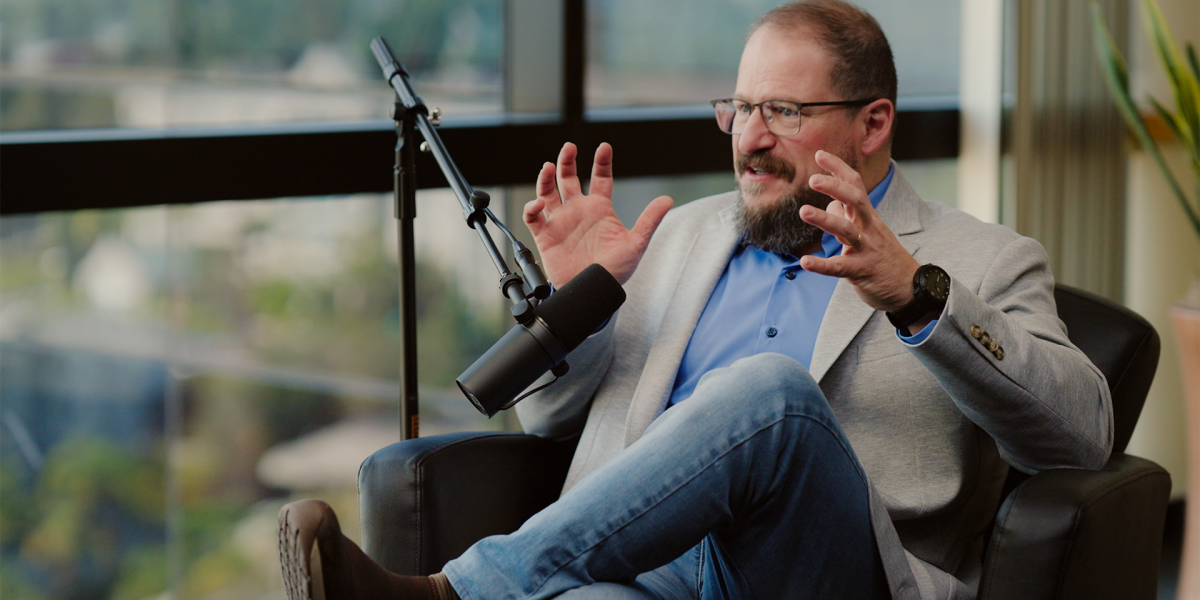
Cristiano Amon won’t tell you what’s coming, but he’ll tell you who’s building it.
“There are some secret form factors that I cannot tell you about,” the Qualcomm CEO said in an interview with Fortune Editor in Chief Alyson Shontell on the Titans and Disruptors of Industry podcast. “But I think we’re working with pretty much all of them.”
“Pretty much all of them,” in this case, means the AI companies racing to build the device that replaces the smartphone. OpenAI, Meta, and others that Amon declined to name in an interview from the company’s San Diego headquarters. This device won’t be something you can hold; it’ll be “things you wear”: glasses, jewelry, pins, pendants. And it’ll center on the idea that the center of digital life will no longer be a phone but an autonomous agent.
The interview was recorded before TF International Securities analyst Ming-Chi Kuo reported in late April that Qualcomm and MediaTek are jointly designing a custom chip for an OpenAI smartphone, with Luxshare manufacturing it. Kuo projected mass production in 2028 and shipments of 300 to 400 million units annually, a number that would put OpenAI in iPhone territory for hardware scaling. Qualcomm shares jumped as much as 13% following the report, though neither company confirmed it.
One problem with that initial report: a smartphone doesn’t track with what Amon said about non-phone hardware. And a more recent Kuo note, dated May 5, says the phone chip may now go to MediaTek alone, with mass production fast-tracked to early 2027.
Whatever happens to Qualcomm’s spot on that specific device, Amon’s framing is bigger than any one chip: Qualcomm will provide the silicon underneath AI’s push into consumer hardware, period.
The “ecosystem of you”
Amon’s pitch is that the smartphone-centric world Qualcomm helped build is coming to an end. In its place, he describes what he calls the “ecosystem of you”: glasses with cameras pointed at whatever you’re pointing at, earbuds that hear perfectly what you hear, and an agent that ties them together and operates across all of them.
“If AI understands what we say, what we hear, what we see—glasses are very close to your eyes, your ears, your mouth,” he said. “All of this information is going to be very important context for agents to do things for you.”
The concept of a “digital twin” might sound dystopian. But the use cases he described are mostly low-friction errands: for example, if you’re looking at a restaurant bill, the agent pays it. Looking at a product, the agent prices it. A meeting pops up, and the agent calls the doctor’s office to reschedule.
This year is the year of the agents, Amon said, in the sense that everyone is playing with giving artificial machines some autonomy over their lives. This year, the devices will be on the market. But by 2027, 2028, Amon claimed, they’ll be unavoidable; “it’s going to be very, very natural.”
He’s bullish on glasses as the leading form factor, but also bullish on the idea that the competition will be too fierce to produce a single winner. “Not everybody wears the same clothes, not everybody wears the same glasses,” he said.
He pointed to ByteDance as the early proof of concept. In December, the TikTok parent launched the Doubao Mobile Assistant on a ZTE-made handset, the Nubia M153, a phone in which the AI agent operates the software, navigating apps, booking tickets, and making payments. The launch sold out its initial run of roughly 30,000 units and prompted Tencent CEO Pony Ma to call the device “extremely unsafe and irresponsible.” Meituan, WeChat, and Alibaba moved within days to restrict Doubao’s access to their apps, but ByteDance, undeterred, is now planning a second-generation device for the second quarter of 2026.
“Nobody paid attention to that, but we said it on the last earnings call,” Amon said. “The control point of the industry is changing. It’s not about the OS and the App Store. It’s going to be what are the agents that you select.”
For most people, the idea of ceding control to a robot is out there at best; downright terrifying at worst. But Amon isn’t a pessimist—he thinks we’ll get used to it, just like we got used to the internet and the smartphone.
“Like every new technology, you can misuse it, you’re going to have some drawbacks,” he said. “But in aggregate, what the smartphone enabled is connecting everyone, empowering people with information. And I think AI has this capability to empower people.”