


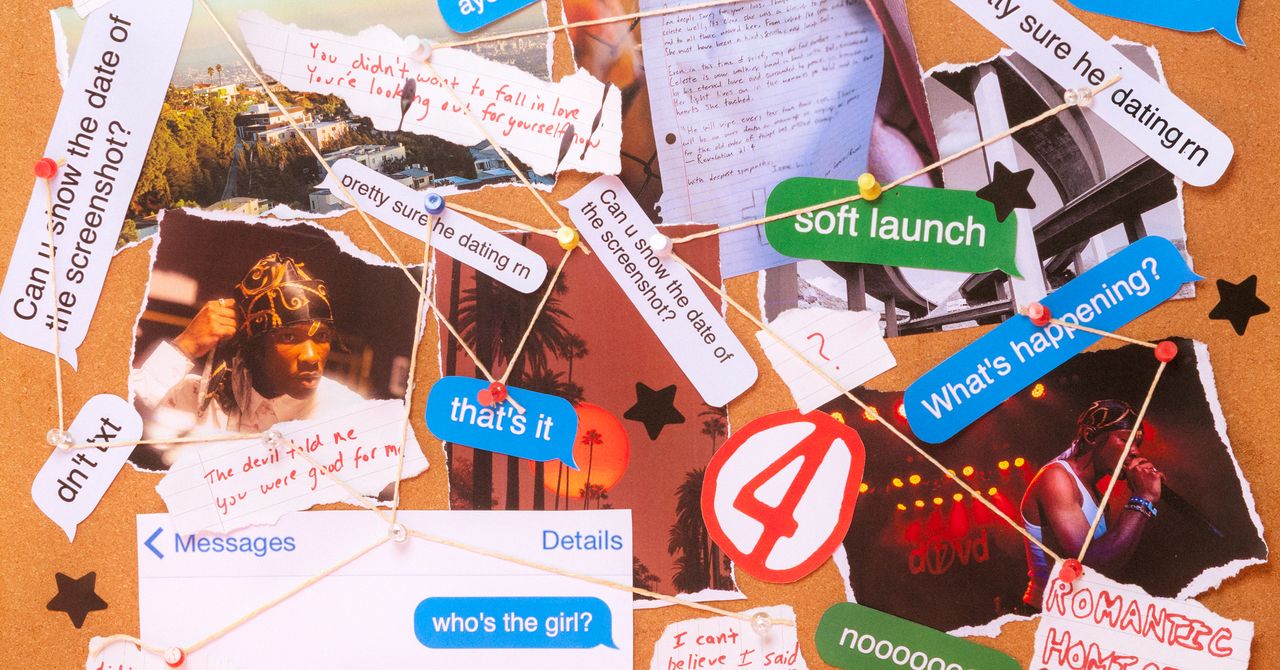
“He was grinding. He was posting every day, playing every day, he was trying his hardest to get somewhere,” says a 21-year-old New York–based gamer who goes by the username Sacred WTF. “Bro, I would just wake up sometimes and it would just be multiple posts from him. He was just trying to pop off, just get one good video.”
By 2021, D4vd was 16 and already building a brand as a socially awkward outcast who spent nearly all of his time online. (It helped that he was homeschooled.) Sometimes, it paid off: When he started catering to the YouTube algorithm by adding popular songs to his Fortnite videos, they racked up hundreds of thousands of views and generated “a lot of money” in ad revenue, he’d later tell musician Benny Blanco in an interview. But those massive views also brought copyright strikes—warnings from YouTube, prompted by record labels, to remove the songs or risk getting booted from the platform. That’s when, according to the now mythic origin story that D4vd has relayed in the press, his mom had a life-altering suggestion: Why didn’t her son make his own damn music?
Using his iPhone, a pair of earbuds, and a mobile app called Bandlab, D4vd—he adopted the moniker around this time, in part for search engine optimization—huddled in his sister’s closet and recorded himself freestyling over a royalty-free piano beat he found on YouTube. He uploaded the track, called “Run Away,” to Soundcloud in December 2021 and tagged it with keywords that helped it go viral: #emo #chill #lowfi #slowedandreverb #blowthisup #foryoupage.
But it wasn’t until July 2022, when he self-released the brooding ballad “Romantic Homicide,” that the then-17-year-old really blew up. Two months later, D4vd signed a deal with Interscope Records’ Darkroom imprint. The comparisons to Billie Eilish, who also scored a deal with Darkroom as a teenager after uploading tracks to Soundcloud, were immediate. In magazine profiles, D4vd was heralded as a new kind of wunderkind: a sheltered gamer who accidentally became a pop star, seemingly overnight. GQ dubbed him a “mouthpiece for Gen-Z heartache.” NME declared he was a “multi-genre visionary.” And Billboard christened D4vd “one of alternative music’s most promising new artists.”
“When I found him, it was like, ‘Wow, he made this in his closet on headphones, on Bandlab. That’s so cool. I could do that, too,’” says Ykare, a popular TikTokker who used to dream about collaborating with D4vd. “That was his whole thing. That was his claim to fame. I think that’s really what brought in a lot of younger audiences.”
Before Ykare found his niche—dressing as a Teletubby and singing in the shower—he was inspired by D4vd’s humble beginnings. “People looked up to him,” Ykare says, because of D4vd’s explosive breakout from a “homemade, ‘I made this in my bedroom’ niche. That’s where D4vd lived, and he kind of was the most successful to do that.”
D4vd communicated with his super-young fans through his Discord. His server was created by a fan named Moji around the time he signed his record deal. Though not officially affiliated with Darkroom, the Discord had a clear benefit to the label: It was a way to promote releases, tour dates, and merchandise directly to superfans. Moderators, which were mostly other fans but also included at least one member of D4vd’s management team, Mogul Vision, and occasionally D4vd himself, shared links to new content and encouraged members to subscribe to D4vd’s email list for presale ticket codes. (Neither Mogul Vision, Darkroom, Interscope Geffen A&M Records, nor its parent company, Universal Music Group, responded to a request for comment.) The tactics also cemented D4vd’s perceived authenticity as a chronically online teenager without much media training.