


On June 12, 1776, the day after the Committee of Five was appointed, the Pennsylvania Gazette printed Virginia’s Declaration of Rights. It begins by stating “that all men are by nature equally free and independent, and have certain inherent rights, of which, when they enter into a state of society, they cannot, by any compact, deprive or divest their posterity; namely, the enjoyment of life and liberty, with the means of acquiring and possessing property, and pursuing and obtaining happiness and safety.” Jefferson, now working on the Declaration of Independence, nicely tightened that up.
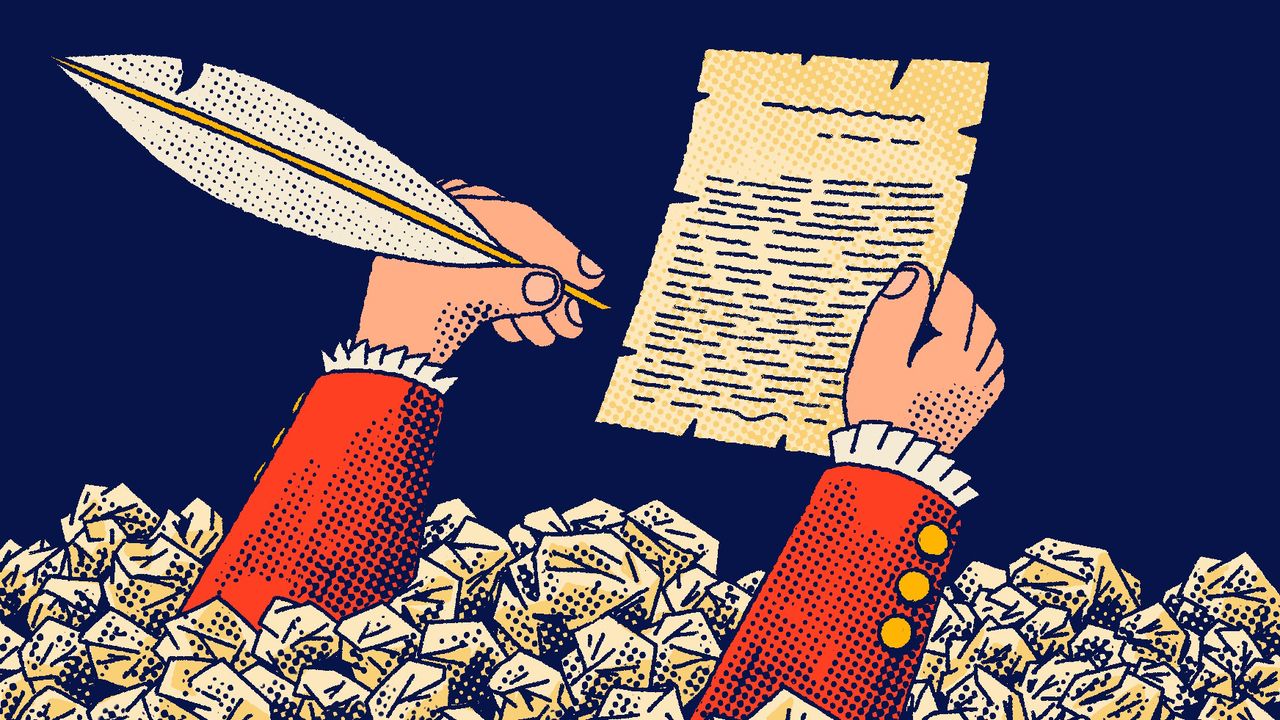
He was also busy writing a document he cared about far more. Not knowing how far along the writing of the Virginia constitution was, Jefferson sent to Williamsburg his own draft. He completed a third draft of the state constitution sometime before June 13, 1776. It included a number of radical provisions, including the complete abolition of slavery (“no person hereafter coming into this country shall be held within the same in slavery under any pretext whatever”) and the stipulation that, at least as concerned inheritance, “females shall have equal rights with males.” Like “ready money” and “sells hats,” “no slavery” and “equal rights for women” were edited out. Didn’t the picture of the hat say it all?
Jefferson’s draft having arrived too late, the Virginia delegates set it almost entirely aside, though they retained Jefferson’s list of grievances against the King, placing the list between the document’s Declaration of Rights and its framing of the new government. The Committee of Five presented the draft Declaration of Independence to Congress on June 28th. Virginia declared independence from England and adopted its new constitution on June 29th. And then Benjamin Franklin told Thomas Jefferson a tall tale about a hatmaker’s sign.
If there are many more befores to the Declaration of Independence than most Americans are wont to consider, there are also a great many more afters. The original parchment was rolled up and stored in the office of the secretary of the Continental Congress, but was then moved around a fair amount during the war—bouncing around towns and cities in Pennsylvania, Maryland, and New Jersey before ending up, in 1785, in New York. It then moved with the national capital: back to Philadelphia, in 1790, and then to Washington, ten years later. It was first displayed to the public only in 1841, in what was then the U.S. Patent Office. In 1876, the document’s centennial, it was carried back to Philadelphia, where it was exhibited at Independence Hall, considerably yellowed and faded—a decay that occasioned much concern and public outcry and led to decades of largely unsuccessful efforts to preserve the parchment before it was put on display at the Library of Congress, in 1924. Not until 1952 was the Declaration, with the Constitution, moved to its current home, in the National Archives, under armed guard.
The parchment lay largely hidden for more than fifty years, but printed versions circulated immediately. John Dunlap, the Continental Congress’s printer, issued the first typeset copies of the Declaration of Independence on July 4, 1776, fitting it all on a page, a giant broadside. Jonas Phillips, a Jewish merchant in Philadelphia who kept a drygoods store on Market Street, folded up a copy and tucked it into a letter he sent to Amsterdam. “The enclosed is a declaration of the whole country,” Phillips wrote. “How it will end, the blessed God knows!” Phillips’s letter was among the bags of mail that were seized by British warships as they stopped American vessels during the war; it never reached its destination. But, in 1787, Phillips petitioned the Constitutional Convention for a provision to be made in the new federal Constitution which would guarantee religious liberty. He wrote to George Washington, who presided over the Convention, “I solecet this favour for my Self my Children and posterity and for the benefit of all the Israelites through the 13 united States of america.” (In 1834, Phillips’s grandson Uriah Phillips Levy purchased Monticello, Jefferson’s mountaintop home, and turned it into a private monument dedicated to religious liberty. In 1923, a year before the Library of Congress displayed the Declaration of Independence for the first time, Jonas Phillips’s descendants sold Monticello to a foundation, which opened it to the public.)