


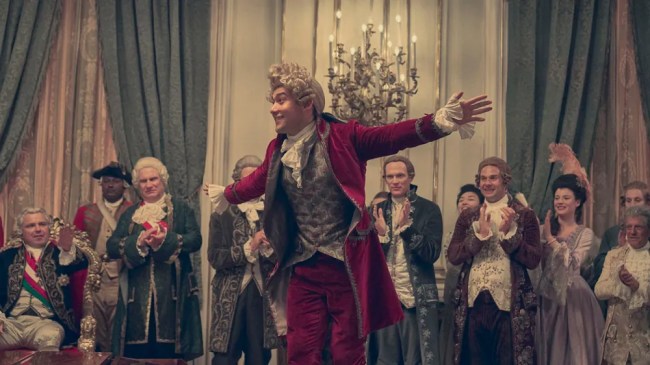
During their lifetimes, Wolfgang Amadeus Mozart and Antonio Salieri were reportedly regular collaborators with a healthy mutual respect for each other’s immeasurable musical talents. In death, however, the composers have repeatedly been depicted as the classical period’s answer to Tupac and Biggie.
Ever since Alexander Pushkin stirred the pot with 1830 play “Mozart and Salieri,” Nikolai Rimsky-Korsakov’s same-named 1879 opera, Peter Shaffer’s 1979 Broadway hit “Amadeus,” and its eight-time Oscar-winning adaptation directed by Miloš Forman have all run with the juicy — but heavily distorted — narrative of a rivalry so intense it resulted in a plot to murder.

First screened in the UK last Christmas, Starz import “Amadeus” continues to amplify one of the 18th century’s most enduring conspiracy theories. In fact, the opening episode concludes with Paul Bettany’s Salieri (in some unconvincing aging makeup) recalling from his deathbed how he bumped off his rival with a near-palpable sense of glee.
While undoubtedly adding to the list of works essentially besmirching the reputation of an innocent man, writer Joe Barton at least makes it evident from the offset that the five-parter isn’t intended as a beacon of historical accuracy.
Indeed, good luck finding any official texts which confirm Mozart once ejaculated onto a buffet’s cake display shortly after eating a strawberry retracted from a part of his lover’s anatomy, a scene more “Saltburn” than Salzburg. Or that Salieri once masturbated over his beloved piano in an unfruitful attempt to cure his writer’s block.
As well as deepening the beef’s mythology, “Amadeus” is clearly heightening its salaciousness.
Following a literal cold open in which the elderly Salieri jumps from a second story window onto a snow-covered courtyard, “Amadeus” heads back to Vienna 1781, where the titular maestro has just arrived to seek his fame and fortune.
“Firstly, I apologize,” he tells his landlady’s daughters shortly after vomiting on the streets outside his new residence. “Secondly, good day.” Will Sharpe, reuniting with Barton after playing a drug-addicted sex worker in crime drama “Girl/Haji,” nails the composer’s blend of debauchery, decadence, and diffusive charm in one fell swoop.
While Sharpe’s casting was inevitably, and depressingly, dismissed as another sign of wokeism gone mad, the half-Japanese/half-British actor ultimately brings something new to the table. His Amadeus can still be monstrous — see how he publicly berates a young fan boy for his inability to recreate his own musical genius, for example. But largely abandoning the manic energy and John McEnroe-inspired petulance of Tom Hulce’s Academy Award-nominated turn, he delivers a slightly more nuanced portrayal, one that continually shifts sympathy and explains why everyone,bar Salieri, initially fell under his spell.

Furthermore, Sharpe spent six months learning how to tinkle the ivories, an impressive commitment which pays off during the pivotal piano battles and ensures a welcome absence of clumsy cutaways from fingers to face.
Nevertheless, in a role reversal of their characters’ pecking order, Sharpe still plays second fiddle to Bettany, the latter serving up a potential career-best as a man whose disdain for the new kid on the block seeps into everything from his own creative exploits to his once-unwavering faith in Catholicism. “The traveling maestro, wrote his first aria in the womb,” Salieri snides when he learns Mozart is about to hit town, a jealous streak which manifests itself in increasingly ugly ways.
Bettany is particularly impressive during the pair’s early exchanges, when Salieri’s initial thoughts of mentorship give way to disbelief that someone so disrespectful of society’s norms has managed to ingratiate himself into its upper echelons, as well as how someone so undedicated to his craft can be so brilliantly prolific. You can almost see him burst a blood vessel trying to contain the simmering rage as the glitterati offer Mozart the adulation he believes is his God-given right.
Of course, Salieri’s quest for vengeance becomes so obvious even his permanently inebriated rival eventually recognizes his so-called friend is more interested in becoming a foe. “Maybe God doesn’t speak to you because you fucking bore him,” Mozart bellows after Salieri cowardly fails to defend the ground-breaking requiem Emperor Joseph (Rory Kinnear) amusingly complains has “too many notes.”
The latter provides much of the comic relief as a man whose cultural voice far outweighs his knowledge. “A return to past success is what’s needed in difficult times,” he insists about the revival of a French opera Salieri is vehemently opposed to. Thankfully, the show itself, clearly recognizing it lacks the sumptuous budget of mid-’80s Hollywood, largely avoids trading on former glories.
No stranger to others’ works having successfully adapted supernatural horror “The Ritual” and young adult fantasy “Half Bad” (“The Bastard Son and the Devil Himself”), Barton also stamps his mark here. A minor character in most iterations, Mozart’s singer wife Constanze is promoted to third billing, with Gabrielle Creevy excellent as a woman forced to put her own ambitions aside to support those of a husband she grows to despise (“He’s useless, chaotic, and no one knows what to do with him”).
“Amadeus” also delves further into why its maestro was so self-destructive, from his disapproving daddy issues and death of his first-born to the internal pressures of possessing such an all-consuming gift, culminating in a magnificent final showdown in which the now-sworn enemies confess all. And it brings several new real-life figures into the fold, including Mozart’s librettist ally Lorenzo Da Ponte (Ényì Okoronkwo) and Pushkin (Jack Farthing), aka the playwright who first immortalized the idea of a battle-to-the-death feud.
The latter helps the oft-told tale take its most meta turn in a final episode which challenges the reliability of everything that’s gone before while theorizing exactly how the myth came to be. It’s an approach which single-handedly justifies a show many of the film’s purists have argued doesn’t need to exist. Salieri might still be declaring himself “the patron saint of mediocrities.” This saucy, yet still suitably operatic interpretation, however, deserves more than such faint praise.
“Amadeus” premieres Friday, May 8 on the STARZ app, plus all STARZ streaming and on-demand platforms. New episodes will be released weekly.