


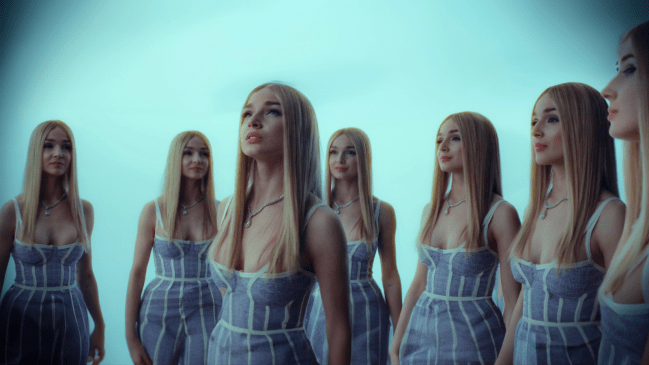
In 2024, the singer and YouTuber Poppy participated in a peculiar piece of performance art and “ventriloquism.” She trained an AI large language model on all of her YouTube videos and had it dictate what she would say in a conversation on stage. The experiment was a good example of how Poppy, in her work and appearances, has blurred the lines between who is the artist and who is the real person, as the answers that were fed to her were based on her own experience.
Paul Trillo, an AI filmmaker, had the idea to take that concept one step further: what if a pop star willingly gave up all of their own autonomy to AI? That’s the premise of his short film starring Poppy as a version of herself called “The Most Perfect Perfect Person.”

It’s a film skeptical and fearful about the threat of AI from a filmmaker who is one of the early adopters and evangelists of generative AI filmmaking. And what makes his short fascinating, which you can watch above, is how the blend of analog filmmaking techniques with generative AI VFX is specifically designed to blur the lines between what is real and what is artificial.
IndieWire can exclusively premiere the full film, as well as a VFX feature in which you can see how the short, largely captured in-camera with real actors, uses AI in some clever, sometimes imperceptible ways. Trillo explains that he had a minimal budget and was in a position where reshoots weren’t an option. AI then allowed him to make minor dialogue tweaks, to massage the edit, or remove unwanted elements from the frame.

The film has some inklings of “The Substance” if it was about a YouTube star, but it’s an original concept in which we see sanitized, corporatized, “perfect” versions of Poppy continually replace other “perfect” versions — visualized with a Poppy clone plummeting through a hole in the floor of a pristine white void onto a dark scrap heap of other Poppys — every time one AI thinks or speaks slightly out of line. Trillo and executive producer Edward Saatchi of AI company Fable Studios cheekily describe “The Most Perfect Perfect Person” as the first AI-generated film based on a true story.
That’s not literally accurate, but the movie is inspired by some of Poppy’s own life experiences, such as how she sometimes might wish to turn her brain off when engaging in frustrating press events or deal with stalkers at fan appearances. And the prevalence of people embracing AI-generated music and synthetic pop stars (just look at a recent music video from Tilly Norwood that feels like pure rage-bait for AI haters) are themes Trillo wanted to explore and critique, even as he himself embraces artificial intelligence.
“I felt like it was mirroring a lot of the code switching that people do online, just organically, how people become bots as you type on Instagram or you phrase something for LinkedIn,” Trillo told IndieWire. “We have these other online personalities that are not ourselves, or pruning parts of our personality for the internet. We’re curating a version of ourselves that we present online, a space in which all AI is trained on. AI only knows what it knows from the internet. It doesn’t actually know how people act outside of the internet. There’s no training data for that.”
While they can’t reveal full details today, the plan is for the Poppy experience to go beyond the film and allow her dedicated following of fans to interact with the film. Saatchi, who is known for his Showrunner platform that allows users to generate their own fan-made episodes of animated series and share them as part of the actual canon of the show, has trained a model on “The Most Perfect Perfect Person” so that viewers will eventually be able to make their own short in the visual aesthetic of the film — complete with a very lifelike Poppy.
The ironic twist that will be apparent with any short that’s generated is that creating a “perfect” Poppy can carry some dark consequences.
“There’s something really interesting about AI being the thing that allows us, thematically and in parts of the film, to create these infinite Poppy’s and what that means for society that a pop star can create many, many versions of themselves,” Saatchi said. “A company can say to a pop star, ‘Hey, we don’t like this first you. They’re too spiky, and we want to create another version of you with AI.’ What happens when AI is going to let every company create a double of its pop stars?”
Trillo has been making movies with AI before it was even a whisper on the WGA’s lips. He got to tinker with the now-defunct Sora before it was released to the public, and “The Most Perfect Perfect Person” was made across several different technologies and model advancements, including Sora, over several years (hardly the “I made this in 15 minutes, Hollywood is cooked” dudes on Twitter). But he believes calling AI good or bad is like labeling the internet as a whole either good or bad with no in between. There’s dangers and benefits in whatever he and other indie filmmakers do with it, and he says it’s on the people that use it to determine if it’s going to help us or replace us.
“I have my own hang-ups AI, and what gets lost beyond actors or artists losing their agency is potentially creating a more stagnant, uninteresting culture where we’re not providing anything new; we’re just rehashing the same things over and over again, and coddling people in nostalgia and coddling people in the familiar versus providing something that hasn’t been seen before,” Trillo said. “Hollywood is already dangerously barreling towards this without AI, and I do fear that AI could exacerbate this problem of recycling and rehashing material. So I have my hang-ups, but I also think for independent filmmaking, it can be hugely beneficial.”
Watch “The Most Perfect Perfect Person” above.